 Smthing Creations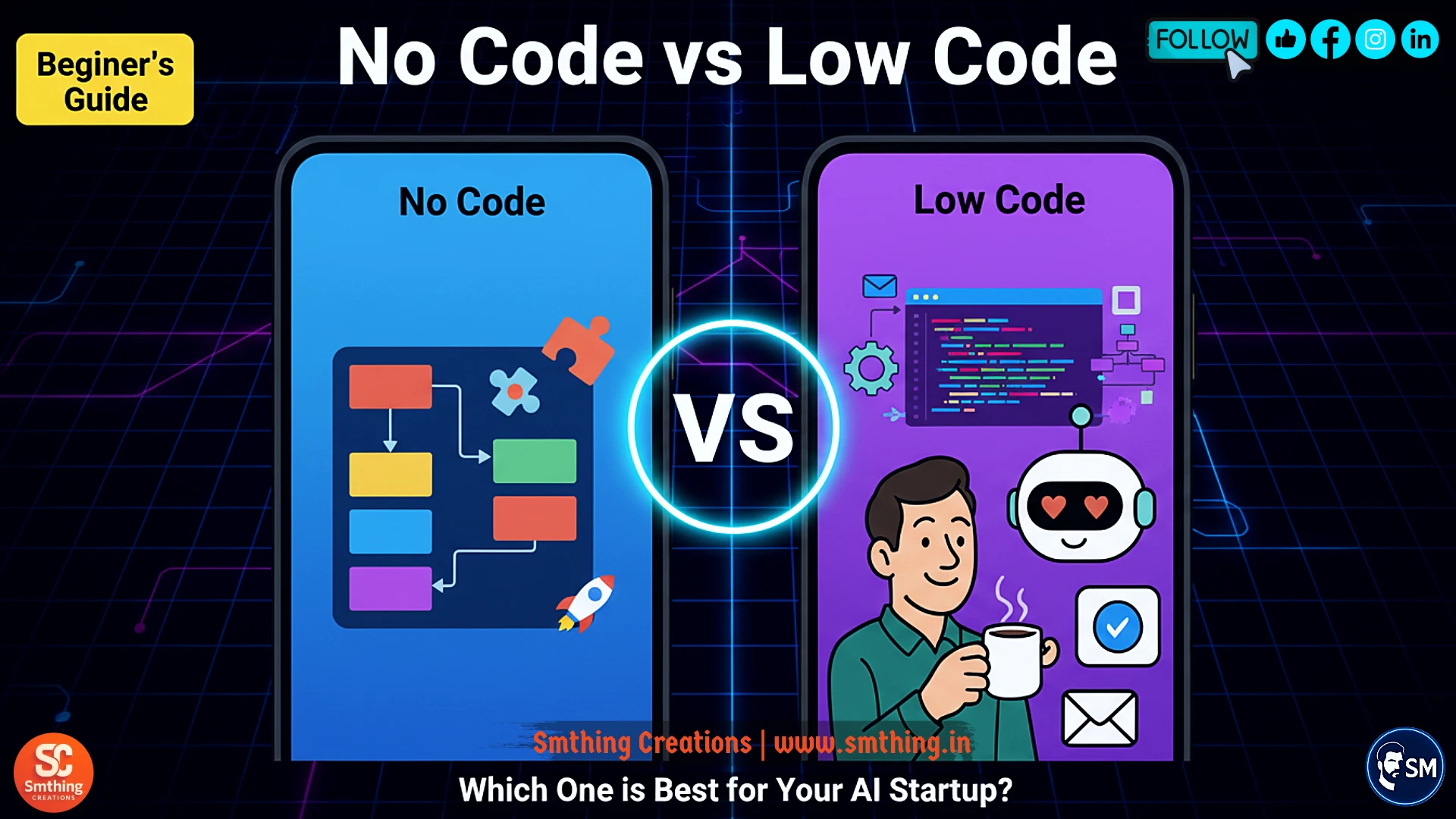
Introduction: The New Era of AI Building
Imagine having a brilliant AI startup idea - maybe a tool that helps restaurants predict customer preferences, or a chatbot that writes personalized workout plans. Five years ago, turning this idea into reality would have required hiring expensive developers or spending months learning complex programming languages. Today, the landscape has completely changed. Thanks to revolutionary No Code and Low Code platforms, anyone with a great idea can build functional AI applications without writing a single line of traditional code.
This transformation is democratizing entrepreneurship in ways we've never seen before. Non-technical founders are launching successful AI startups, researchers are turning their insights into profitable tools, and creative professionals are building sophisticated automation systems. The barriers that once separated great ideas from great execution are rapidly disappearing. Whether you're a complete beginner or someone hesitant to enter the tech world, this guide will help you understand exactly how to choose the right approach for your AI startup dreams.
Understanding No Code: The Digital Lego Approach
Think of No Code platforms like digital Lego sets, but instead of building castles or cars, you're building websites, apps, and AI-powered tools. Just as you'd snap colorful Lego blocks together to create something amazing, No Code platforms let you drag and drop pre-built elements - buttons, forms, databases, and AI features - to create functional applications. There's no need to understand complex programming syntax, database structures, or server management. Everything is visual, intuitive, and designed for people who think in terms of workflows rather than code.
The beauty of No Code lies in its simplicity and speed. You can go from having an idea on Monday to having a working prototype by Friday. Popular No Code platforms like Bubble, Glide, Webflow, and Zapier have pre-built templates and components specifically designed for AI applications. For example, you could use Glide to transform a simple Google Spreadsheet containing customer feedback into a mobile app that automatically analyzes sentiment using AI. The platform handles all the technical complexity behind the scenes, while you focus on solving your customers' problems and refining your business logic.
Understanding Low Code: The Customizable Blueprint Approach
Low-code platforms occupy the middle ground between no-code simplicity and traditional programming complexity. Think of them as sophisticated blueprint systems that give you a visual foundation to work with, but also allow you to add custom elements when needed. While you still use drag-and-drop interfaces for most of your application, Low Code platforms let you inject custom code snippets, integrate with specialized APIs, and create more complex workflows that might not be possible with purely visual tools.
This approach is perfect for AI startups that need more flexibility than No Code can provide, but don't want to build everything from scratch. Platforms like LangChain, FlutterFlow, Retool, and Streamlit offer this balanced approach. For instance, you might use LangChain to build a customer support chatbot that not only responds to queries but also remembers previous conversations, learns from interactions, and integrates with your existing customer database. The platform provides the framework and visual tools, but you can customize the AI behavior with specific code snippets to make it work exactly as your business requires.
Real-World Applications: When to Use Each Approach
No Code Success Stories
Let's explore some practical scenarios where No Code shines for AI startups. Consider a fitness coach who wants to create a personalized meal planning app. Using a no-code platform like Bubble, they can create a user interface where clients input their dietary preferences, fitness goals, and restrictions. The app then connects to OpenAI's API to generate customized meal plans, shopping lists, and nutritional advice. The entire process - from user registration to AI-powered recommendations to payment processing - can be built without writing code, and launched within a week.
Another excellent No Code application is building AI-powered landing pages for marketing campaigns. Using Webflow combined with AI APIs, a startup can create dynamic websites that personalize content based on visitor behavior, generate custom headlines for different audiences, or even create personalized product recommendations. The visual editor makes it easy to design beautiful interfaces, while built-in integrations handle the AI functionality. This approach is perfect for validating business ideas quickly and cost-effectively before investing in more complex development.
Low Code Success Stories
Low-code platforms excel when your AI startup needs more sophisticated functionality. Imagine building an AI-powered inventory management system for small retailers. While No Code might handle basic inventory tracking, a Low Code approach using tools like Retool allows you to create custom algorithms that predict demand, automatically generate purchase orders, and integrate with multiple supplier APIs. You get the speed of visual development plus the flexibility to implement complex business logic that gives your startup a competitive advantage.
Another powerful low-code application is creating AI agents with memory and context awareness. Using platforms like LangChain, you can build chatbots that remember previous conversations, learn from user interactions, and make intelligent decisions based on historical data. For example, a mental health startup could create an AI counselor that tracks mood patterns over time, remembers previous sessions, and provides increasingly personalized support. This level of sophistication requires the flexibility that Low Code provides, but still maintains much of the speed and accessibility that makes these platforms attractive to non-technical founders.
Detailed Comparison: No Code vs Low Code Features
Development Speed and Learning Curve
No-code platforms are designed for immediate results. Most founders can build functional prototypes within days of starting, even with zero technical background. The learning curve is gentle - you're essentially learning to use sophisticated software rather than learning programming concepts. Templates and tutorials are abundant, and the visual nature makes it easy to understand what each component does. However, this speed comes with limitations in terms of what you can build and how you can customize it.
Low-code platforms require a slightly steeper learning curve but offer much greater flexibility. You'll need to understand basic concepts like APIs, databases, and how different systems communicate with each other. However, you don't need to master full programming languages. Most founders can become proficient in Low Code platforms within 2-4 weeks of focused learning. The extra time investment pays off with applications that can grow and adapt as your startup evolves, rather than hitting platform limitations that require complete rebuilds.
Customization and Scalability
No-code platforms excel at solving common problems quickly but struggle with unique requirements. If your AI startup needs standard features - user authentication, payment processing, basic AI integrations - No Code is perfect. However, if your competitive advantage depends on unique algorithms, custom AI models, or specialized integrations, you'll quickly hit limitations. Additionally, most No Code platforms have usage limits that can become expensive as your startup grows, and performance may decline with high user loads.
Low-code platforms shine when your startup needs custom features or plans to scale significantly. You can implement proprietary algorithms, integrate with specialized AI services, and build complex workflows that give your startup unique advantages. Scalability is generally much better, as you have more control over performance optimization and can handle larger user bases without hitting platform constraints. The trade-off is increased complexity and the need for some technical understanding, but the flexibility often justifies this investment for serious startups.
Cost Analysis: Budget Considerations for Startups
Understanding the financial implications of your platform choice is crucial for startup success. No-code platforms typically follow subscription models ranging from $29 to $200 per month, depending on features and usage limits. These costs are predictable and often include hosting, security, and basic support. For early-stage startups validating ideas or building simple applications, this represents excellent value. However, costs can escalate quickly as you add users, increase data usage, or require premium features. Some platforms charge based on the number of app users or API calls, which can become expensive if your startup gains traction.
Low-code platforms often have higher base costs, typically ranging from $100 to $500 per month, plus potential developer costs if you need custom code implementation. However, these platforms often scale more cost-effectively than No Code solutions. As your user base grows, the per-user costs typically decrease, and you have more control over hosting and infrastructure expenses. Additionally, the ability to implement custom features in-house rather than paying for premium platform add-ons can result in significant long-term savings. Many successful startups find that Low Code becomes more economical than No Code once they exceed 1,000 active users.
Technical Requirements and Skill Development
No-code platforms are designed for complete beginners with no technical background. If you can use Microsoft Word or create a PowerPoint presentation, you can learn to use No Code tools effectively. The skills you develop are primarily around understanding user experience, workflow design, and business logic. These are valuable entrepreneurial skills that transfer well to other aspects of running a startup. The main limitation is that you're constrained by what the platform provides - if it doesn't exist as a pre-built component, you probably can't build it.
Low-code platforms require developing some technical literacy, but not traditional programming skills. You'll need to understand concepts like APIs (how different software systems communicate), databases (how information is stored and retrieved), and basic logic structures (how to create conditional workflows). Most founders can acquire these skills through online tutorials and practice. The investment in learning pays dividends by giving you much greater control over your startup's technology stack and the ability to implement competitive advantages that pure No Code solutions can't achieve.
AI Integration Capabilities
No-code platforms excel at integrating with popular AI services through pre-built connectors. Connecting your application to OpenAI's GPT models, Google's AI services, or other mainstream AI APIs is typically a matter of entering API keys and configuring basic settings through visual interfaces. This makes it easy to add features like text generation, image analysis, or basic chatbot functionality to your applications. However, you're limited to surface-level integrations and can't fine-tune AI models or implement complex AI workflows that might give your startup a competitive edge.
Low-code platforms provide much deeper AI integration possibilities. You can implement custom AI workflows, chain multiple AI models together, fine-tune models with your specific data, and create sophisticated AI agents that learn and adapt over time. This flexibility allows AI startups to build truly differentiated products rather than just using AI as a generic feature. For example, you could create an AI system that combines natural language processing, computer vision, and predictive analytics in ways that are specifically optimized for your industry and use case.
Popular Tools and Platforms
Leading No Code Platforms for AI Startups
Bubble stands out as one of the most comprehensive no-code platforms for building web applications with AI features. It offers a visual programming interface where you can create complex workflows, integrate with external APIs, and handle user management and payments. Bubble is particularly strong for AI startups building Software as a Service (SaaS) applications, as it can handle everything from user onboarding to subscription management while seamlessly integrating with AI services.
Glide specializes in turning spreadsheets into mobile and web applications, making it perfect for AI startups that want to quickly prototype data-driven applications. You can connect your Google Sheets or Excel files to AI services, creating applications that analyze data, generate insights, or provide AI-powered recommendations. Webflow excels at creating marketing websites and simple web applications with AI features, offering beautiful design capabilities combined with the ability to integrate with AI APIs for dynamic content generation.
Leading Low Code Platforms for AI Startups
LangChain has emerged as a powerful platform for building AI applications that require complex workflows and memory. It's particularly valuable for startups creating AI agents, chatbots with context awareness, or applications that need to chain multiple AI models together. While it requires some technical understanding, LangChain provides frameworks and templates that significantly accelerate AI application development compared to building from scratch.
Retool focuses on building internal tools and dashboards quickly, making it excellent for AI startups that need to create admin interfaces, data analysis tools, or customer support dashboards. FlutterFlow enables mobile app development with AI features, providing visual development tools while allowing custom code integration when needed. Streamlit specializes in creating data applications and is particularly popular among AI startups that need to build prototypes, demonstrate AI models, or create data visualization tools.
Decision Framework: Choosing Your Path
When No Code Is the Right Choice
Choose No Code if you're in the idea validation phase and need to test your concept quickly and cheaply. If your AI startup idea can be implemented using existing AI services like OpenAI, Google AI, or other mainstream providers, no-code platforms can get you to market faster than any other approach. This is particularly true if your competitive advantage lies in business model innovation, market positioning, or customer acquisition rather than unique technology. No Code is also ideal if you're a solo founder without technical co-founders and want to maintain complete control over your product development.
No Code excels for AI startups focused on specific industries or use cases where the AI functionality is relatively straightforward. For example, content generation tools, simple recommendation engines, basic chatbots, or AI-powered form processors can all be built effectively with No Code platforms. If your startup plans to operate in a niche market where speed to market is more important than technical sophistication, No Code provides the fastest path to revenue generation and customer validation.
When Low Code Is the Right Choice
Low Code becomes essential when your AI startup's competitive advantage depends on unique technology, custom algorithms, or sophisticated AI workflows that aren't available through standard API integrations. If you need to process large amounts of data, implement proprietary machine learning models, or create AI systems that learn and adapt based on user behavior, Low Code platforms provide the flexibility to build these differentiating features while still maintaining development speed.
Consider Low Code if you have technical team members or plan to hire developers in the future. The platforms provide a bridge between visual development and traditional coding, making it easier to transition as your team grows. Low Code is also the better choice if you're building for enterprise customers who require custom integrations, advanced security features, or the ability to handle large-scale deployments. The additional complexity pays off when your startup needs to scale beyond the limitations of No Code platforms.
The Hybrid Approach: Best of Both Worlds
Many successful AI startups don't choose exclusively between No Code and Low Code - they use both strategically. A common pattern is using No Code platforms for customer-facing applications and marketing websites while building core AI functionality and internal tools with Low Code platforms. This approach allows startups to move quickly on standard features while maintaining flexibility for proprietary technology. For example, you might use Webflow for your marketing site and customer onboarding, while building your core AI engine with LangChain and managing operations through Retool dashboards.
The hybrid approach also works well for startups that want to validate ideas with No Code before investing in more sophisticated Low Code development. Start with a no-code prototype to test market demand, gather user feedback, and refine your value proposition. Once you've proven product-market fit, you can rebuild core components with Low Code platforms to add advanced features, improve performance, and prepare for scaling. This staged approach minimizes initial investment while ensuring you don't hit platform limitations just as your startup gains traction.
Common Mistakes and How to Avoid Them
One of the most common mistakes AI startup founders make is choosing platforms based on features rather than business needs. It's easy to get excited about Low Code flexibility or No Code simplicity without considering how the choice aligns with your startup's growth trajectory, team capabilities, and competitive requirements. Before selecting a platform, clearly define your minimum viable product requirements, expected user growth over the next 12-18 months, and the technical capabilities of your team. This foundation will guide you toward the right choice rather than getting distracted by impressive platform demonstrations.
Another frequent mistake is underestimating the importance of data ownership and portability. Some no-code platforms make it difficult to export your data or migrate to other systems if your needs change. Before committing to any platform, understand its data export policies, API access, and what happens to your application if you need to move to a different system. Similarly, avoid platforms that create excessive vendor lock-in, where switching costs become prohibitively expensive as your startup grows. Choose platforms that provide clear migration paths and maintain data accessibility even if you decide to change your technology stack later.
Future-Proofing Your AI Startup
The AI landscape is evolving rapidly, with new models, capabilities, and platforms emerging regularly. When choosing between No Code and Low Code approaches, consider how your choice will adapt to future AI developments. No-code platforms often integrate new AI capabilities automatically but may limit your ability to implement cutting-edge features quickly. Low-code platforms require more manual integration work but give you the flexibility to adopt new AI technologies as soon as they become available.
Plan your technology choice with a 2-3 year horizon in mind. Consider not just your current needs, but where you expect your AI startup to be when it reaches maturity. Will you need to handle millions of users? Will you require custom AI models trained on proprietary data? Will you need to integrate with enterprise systems or provide white-label solutions? Your answers to these questions should heavily influence your platform choice today, even if these requirements seem distant from your current reality.
Getting Started: Your First Steps
Begin your AI startup journey by clearly defining your core value proposition and minimum viable product requirements. Write down the essential features your application needs to solve your target customers' primary problem. This clarity will help you evaluate whether No Code platforms provide sufficient functionality or whether you need Low Code flexibility. Create user stories that describe how customers will interact with your AI application, and use these to guide your platform evaluation process.
Start with free trials and proof-of-concept builds on multiple platforms before making a final decision. Most No Code and Low Code platforms offer generous trial periods that let you test their capabilities with your specific use case. Build simplified versions of your core features on 2-3 different platforms to understand their strengths, limitations, and how they align with your development style. This hands-on experience is invaluable for making an informed decision that you'll be comfortable with as your startup grows.
Conclusion: Your Path Forward
The choice between No Code and Low Code isn't just about technology - it's about aligning your development approach with your startup's goals, timeline, and growth ambitions. No Code platforms offer unmatched speed and accessibility for founders who want to validate ideas quickly and focus primarily on business development rather than technical complexity. Low-code platforms provide the flexibility and scalability needed for startups with unique technical requirements or plans for significant growth.
Remember that your initial choice doesn't have to be permanent. Many successful AI startups evolve their technology stack as they grow, starting with rapid prototyping tools and gradually moving toward more sophisticated platforms as their needs become more complex. The most important step is to start building and learning from real users. Whether you choose No Code, Low Code, or a hybrid approach, the key to startup success lies in solving real problems for real customers, iterating based on feedback, and maintaining the flexibility to adapt as you learn what your market truly needs.
The democratization of AI development through these platforms means that great ideas, not just great programming skills, can drive startup success. Your unique understanding of customer problems, combined with the power of modern No Code and Low Code platforms, gives you everything you need to build a successful AI startup. The only question remaining is: what problem will you solve first?