 Smthing Creations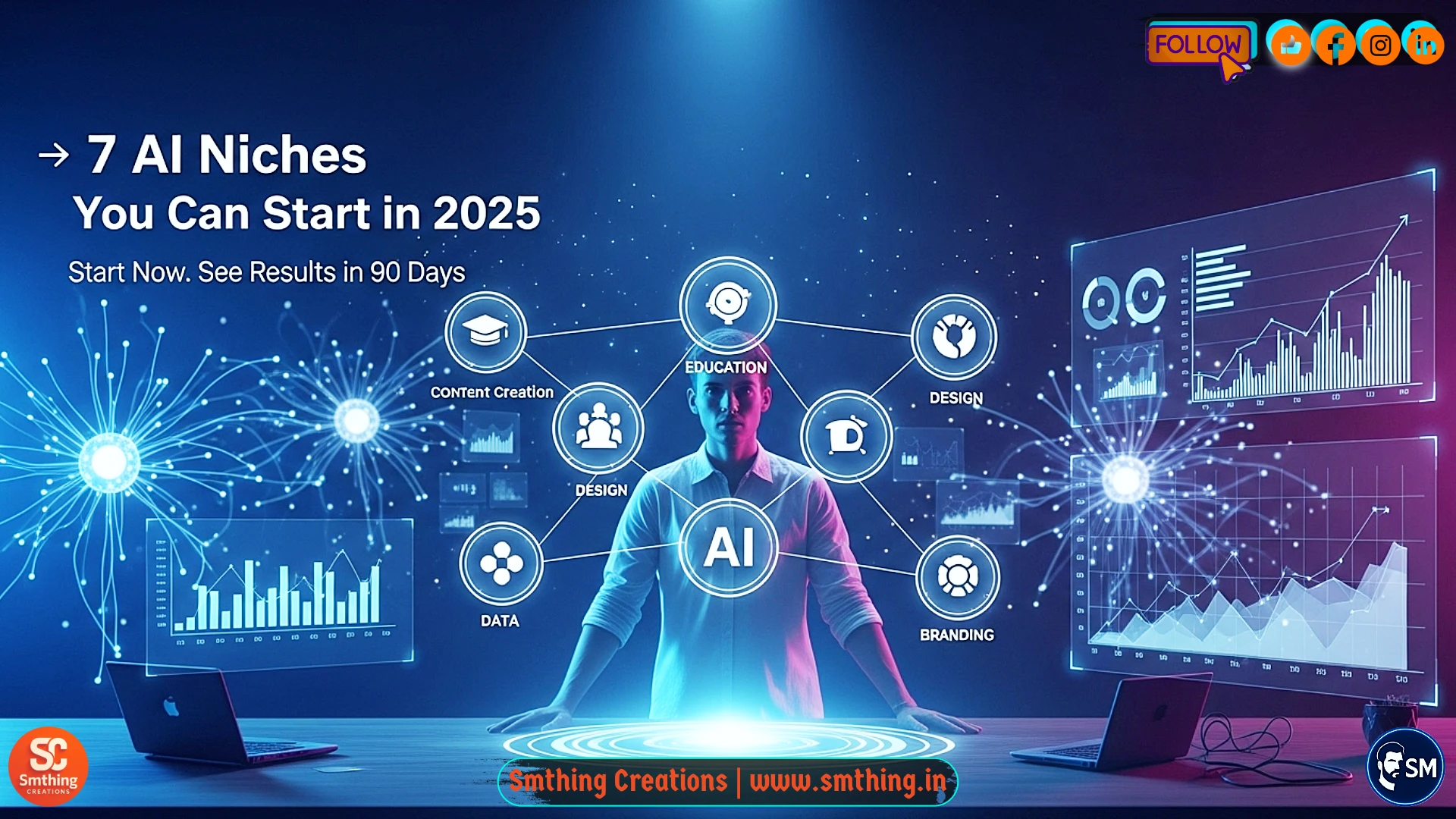
The complete roadmap to building your AI-powered business - no tech degree required
Why 2025 Is the Year to Build an AI-Based Business
AI isn't coming - it's already here. The question is: are you using it to build your next big idea?
We're witnessing something unprecedented. Solo creators are building million-dollar companies from their bedrooms. Small startups are competing with Fortune 500 corporations. Freelancers are transforming into agency owners overnight. The common thread? They're leveraging artificial intelligence to amplify their capabilities far beyond what was possible just two years ago.
The global AI market is exploding toward $1.8 trillion by 20301. But here's what the headlines miss: you don't need venture capital, a computer science degree, or a team of engineers to capture your share. The most successful AI entrepreneurs in 2025 aren't building AI models themselves - they're applying existing AI tools to solve real problems people will pay to have solved.
What This Guide Covers: This article is structured into five essential parts. First, you'll learn what makes an AI niche worth pursuing using three key criteria. Second, we'll explore seven specific AI business niches showing explosive growth right now. Third, you'll discover how to choose the right niche for you. Fourth, we'll provide a detailed 90-day action plan. Finally, we'll share essential AI tools to kickstart your journey.
What Makes an AI Niche Worth Starting in 2025
Understanding "AI Niche": Let's be clear - an AI niche doesn't mean creating new AI models from scratch. That's for researchers at OpenAI and Google. Instead, it means applying existing AI tools to solve specific problems in specific markets. You become the bridge between powerful AI capabilities and people who need them but don't know how to access them.
Three Key Factors for High-Potential Niches
1. Growing Demand: You need evidence that more people are actively searching for AI solutions in that space. Check Google Trends for increasing search volume, explore Reddit communities for frequent problem discussions, and analyze whether new competitors are entering the market. Growing demand creates opportunity for newcomers.
2. Low Competition: Look for spaces where market need exists but hasn't been fully served by high-quality providers. You want markets where some players prove the concept works, but no one has become the undisputed authority yet. This window won't stay open forever - early movers will become established authorities that new entrants must compete against.
3. Clear Monetization Path: People must actually pay for solutions. The best opportunities have multiple monetization options: direct services to clients, digital products like templates or courses, Software-as-a-Service models for recurring revenue, affiliate partnerships, or consulting services. Multiple revenue streams protect you from market changes while maximizing income potential.
The Top 7 AI Niches You Can Start Right Now
1. AI Content Creation & Automation
What it involves: Using AI tools to generate blogs, social media content, advertising copy, and video scripts at scale. You're building systematic processes that consistently produce high-quality, on-brand content for clients who need consistent output but lack time or team resources.
Why it works: Small businesses understand they need consistent content but can't afford full-time writers or premium agencies. AI has changed content economics - what took hours now takes minutes. This creates enormous arbitrage for entrepreneurs delivering agency-quality at freelancer prices.
How to enter: Specialize in one content type and industry (LinkedIn posts for B2B SaaS, blog SEO for local businesses). Build a productized service with clear deliverables and fixed pricing. Create a YouTube channel demonstrating your expertise. Consider offering a micro-SaaS tool that automates specific workflow parts.
2. AI-Powered Resume, Portfolio & LinkedIn Optimization
The opportunity: The job market has shifted - landing jobs isn't just about qualifications anymore, it's about visibility and optimization for both human recruiters and AI screening systems. Most job seekers present themselves poorly despite strong qualifications.
Market validation: Platforms like Teal and Rezi have gained millions of users. Individual consultants charging $200-500 per resume review are fully booked months ahead. Career coaches focusing on LinkedIn growth are building six-figure businesses2.
Your strategy: Become the expert for a specific professional niche (software engineers, healthcare administrators, marketing professionals). Offer tiered services: basic resume review ($97-197), mid-tier with LinkedIn rewrite ($297-497), premium with portfolio website and ongoing support ($597-997). Create AI prompt tools as low-ticket entry points that introduce clients to higher-tier services.
3. AI for Education & Learning Assistants
The revolution: AI enables personalized learning experiences at scale. This includes personalized tutoring bots, AI note summarizers, study scheduling tools, practice quiz generators, and "study with me" companions. Students, lifelong learners, and parents all represent willing markets.
Proven demand: The education technology market will exceed $400 billion by 2026, with AI-powered personalized learning as the fastest-growing segment. Students using AI study assistants show 25-40% better retention than those using traditional methods3.
Building your business: Choose a specific subject and student segment (AP test prep, college STEM tutoring, certification exam prep). Create AI-powered study tools as digital products, build a tutoring practice with AI handling content delivery, or start an educational YouTube channel teaching AI study methods. Partner with subject matter experts to maintain quality and accuracy.
4. AI for Health & Wellness
Personalization at scale: Consumers want personalized meal plans, workout programs, and mental health journaling that feel scientific and customized. AI enables premium-quality personalization at mass-market prices - something previously only available through expensive personal trainers and nutritionists.
Market size: The global wellness market exceeds $4.5 trillion annually. Health outcomes are measurable, making ROI clear. AI-powered meal planning apps generate millions in subscriptions, while mental health journaling apps have millions of active users4.
Responsible entry: Combine expert human knowledge with AI delivery. If you're a certified professional, use AI to scale your services. If not, partner with licensed experts who provide core methodology while you handle AI implementation. Focus on specific conditions or goals rather than trying to serve everyone.
5. AI for Small Business Productivity
The gap: Large enterprises have IT teams implementing AI across operations. Small businesses ($500K-$5M annually) desperately need similar capabilities but lack technical expertise or resources. They're bleeding time on manual processes that could be automated.
Why they'll pay: When you show business owners how to save 10-20 hours weekly through AI automation, they immediately see ROI and willingly pay $2K-10K for implementations. The market is massive — over 30 million US small businesses have implemented zero AI tools beyond built-in software features.
Your approach: Specialize in one industry or process type (AI automation for real estate agencies, customer support for e-commerce, content systems for marketing agencies). Create packaged offerings: "Quick Win Automation" ($1,500-2,500), "Complete AI Transformation" ($5,000-10,000), "Ongoing Optimization" retainer ($500-1,500/month). Market through case studies showing specific time and cost savings.
6. AI for Creative Entrepreneurs (Logos, Designs, Branding)
The opportunity: AI design tools have democratized professional-quality creative work. But access to tools doesn't equal good results - most people need guidance, curation, and expertise to get outputs that actually work for their business. Your expertise differentiates you in a market flooded with raw AI capabilities.
Market demand: Traditional designers charge $2K-10K for brand identity packages, pricing out small businesses. These underserved customers want professional branding but can't justify traditional rates. AI lets you serve this massive market at accessible prices ($300-1,500) while maintaining healthy margins.
Differentiation strategy: Position as "AI + Human" emphasizing your creative direction and brand strategy. Offer tiered packages: "Express Brand Package" ($297-497) with logo variations and guidelines, "Complete Brand Identity" ($997-1,997) with full assets, "Ongoing Creative Partner" retainer ($397-797/month). Build alternative revenue through template sales on Creative Market or courses teaching AI design.
7. AI Data Research & Trend Tracking
The synthesis opportunity: Information overload challenges every professional. Executives, investors, and operators struggle to stay current with relevant developments. AI enables hyper-focused research that synthesizes massive information into actionable insights for specific professional audiences.
Premium pricing: Professionals in biotech, fintech, AI, and marketing make million-dollar decisions based on industry trends. They'll pay $500-5,000+ annually for research services that keep them informed and ahead of peers. Morning Brew grew to an eight-figure acquisition with business news synthesis5.
Building your service: Choose a specific industry where you have knowledge or a strong interest (AI applications in healthcare, fintech regulatory developments, marketing technology trends). Start with a free newsletter to build an audience for 6+ months. Once you reach 1,000+ subscribers, introduce a premium tier ($20-100/month). Expand with custom research reports ($2,000-10,000), dashboard tools ($50-200/month), and paid webinars.
How to Choose the Right AI Niche
The fatal flaw: Most entrepreneurs choose niches based purely on profit potential. They copy someone making $20K/month, then quit six months later because they hated the work. The right niche balances four factors: genuine interest, existing skills or willingness to learn them, validated market demand, and realistic monetization paths.
Three-Step Selection Process
Step 1 - Identify what excites you: Which topics do you naturally consume content about? What problems do you find yourself thinking about? Consider your professional background and personal experiences. Your personal connection to a problem space gives you authentic insights that pure market research can't provide.
Step 2 - Validate demand with data: Use Google Trends to check if search volume is growing. Explore Reddit communities where target customers discuss problems. Use keyword research tools like Ubersuggest to identify high-volume, low-competition keywords. Check platforms like Gumroad and Fiverr to see if people are successfully selling in this niche.
Step 3 - Test with an MVP: Create the simplest version of your offering and get 3-5 paying customers within 30 days. For services, offer manually at 50-70% of the intended long-term pricing. For products, create a single module or guide. This real-world test validates whether people will actually pay at prices that make the business viable.
The 90-Day Action Plan
Why 90 days: Thirty days isn't enough for meaningful traction. Six months is too long without results, leading to abandonment. Ninety days hits the sweet spot - long enough to build momentum, short enough to maintain urgency and focus.
Phase 1 (Days 1-30): Foundation
Weeks 1-2: Become an expert on your niche through research. Interview 5-10 potential customers about their challenges. Define your positioning clearly: Who are you serving? What specific problem are you solving? How is your approach different?
Week 3: Create your minimum viable offer with clear deliverables and outcomes. Set up basic infrastructure: simple website using Carrd, payment processing through Stripe, professional email, and social media presence.
Week 4: Create 4-8 pieces of content demonstrating expertise. Build a lead magnet (checklist, template, mini-guide) to capture emails. Set up email capture using ConvertKit or MailerLite.
Phase 2 (Days 31-60): Launch & Validation
Weeks 5-6: Get your first paying customers through aggressive outreach. Announce to your network. Personally message 50-100 ideal customer prospects. Provide massive value in relevant communities before mentioning your offer.
Week 7: Over-deliver on value for first customers. Ask for feedback throughout. Document your delivery process step-by-step with checklists and templates for consistent future delivery.
Week 8: Collect testimonials and create case studies. Quantify results when possible ("3x more interviews," "reduced time by 15 hours weekly"). Publish results on your website and in social content.
Phase 3 (Days 61-90): Scale
Weeks 9-10: Scale content production to 3-5 posts weekly on your primary platform. Use customer success stories as content topics. Repurpose everything across platforms using tools like OpusClip.
Week 11: Identify complementary businesses or creators and propose collaborations. Guest post, appear on podcasts, and co-host webinars. These partnerships give access to established audiences, dramatically accelerating growth.
Week 12: Start SEO optimization for long-term passive traffic. If you have a budget ($200-500), experiment with small paid advertising tests. Don't scale paid ads until proving positive ROI on small budgets.
Essential AI Tools to Get Started
The foundation: You don't need every tool day one. Start with these core platforms that work across any AI business.
ChatGPT or Claude: Your primary tool for generating content, research, and brainstorming. Learn prompt engineering - be specific about what you want. Create prompt templates for repetitive tasks in your business.
Notion AI: Combine note-taking, project management, and databases with built-in AI. Organize research, manage customers, track content calendars, and maintain your business knowledge base all in one place.
Midjourney or DALL-E 3: Create custom visuals for marketing instead of generic stock photos. Learn basic prompting techniques describing style, composition, and mood. Generate multiple variations and select the best.
Canva: Professional design made accessible with AI-powered features like Magic Write and Magic Design. Use Brand Kit to maintain visual consistency. Create social posts, presentations, and lead magnets in minutes.
Zapier or Make: Automate workflows by connecting different apps. Start with 3-5 high-impact automations saving the most time. Use pre-built templates rather than building from scratch.
Tool strategy: Master one or two tools before adding more. Track time savings to justify costs. Stay lean in your tool stack - the goal is building a profitable business, not collecting impressive tech.
Take Action Today
The unprecedented opportunity: A single person with a laptop, internet connection, and AI tools can build businesses that would have required teams of 10-20 people five years ago. The democratization of capability that AI enables creates opportunities for wealth creation that previous generations couldn't access.
But opportunity alone doesn't create results - action does. Every week, thousands read guides like this, feel inspired, and do nothing. Meanwhile, a small percentage actually start. They choose a niche, build a simple offer, reach out to customers, and iterate based on feedback. These doers capture the opportunities everyone else only talks about.
AI won't replace you - but someone using AI will. This isn't meant to create fear, but to emphasize reality. Every industry is being transformed by AI capabilities. Professionals who leverage these tools will dramatically outperform those who resist or ignore them. In five years, we'll look back at 2025 like we now look at the early internet or smartphones. The businesses built today will be established players. The wealth generated will be substantial. The only question is whether you'll capture a piece of it or watch it happen.
Your next step: Choose one niche from this guide - the one that genuinely excites you and aligns with your skills or interests. Commit to working on it consistently for 90 days. Not sporadic bursts, but steady progress. Thirty minutes daily beats three-hour sessions once a week. Consistency compounds into remarkable results.
Don't wait for perfect clarity, timing, or circumstances. Start with what you have, where you are, with what you know. Launch before you're ready. Publish content that's good enough. Reach out to potential customers even though rejection feels uncomfortable. Every successful entrepreneur started exactly where you are now, with the same doubts.
Pick one niche. Stay consistent for 90 days. Watch the transformation happen.
References
- McKinsey Global Institute. "The Economic Potential of Generative AI: The Next Productivity Frontier." Technology and Innovation Report, 2024.
- Harvard Business Review. "How AI Is Changing the Landscape for Career Development and Personal Branding." Business Innovation Quarterly, 2024.
- Journal of Educational Technology. "AI-Powered Learning Assistants: Impact on Student Retention and Performance." Education Research Quarterly, 2024.
- Global Wellness Institute. "The State of the Global Wellness Economy." Wellness Market Analysis, 2024.
- Forbes. "The Rise of Niche Newsletters: How Specialized Content Creates Seven-Figure Businesses." Entrepreneurship Magazine, 2024.